

NVT - Neurologic Visual Trainer Proprietary Methodology
See our introduction video and text here
1. Neurological Basis & Predictive Modeling
The Neurologic Visual Trainer (NVT) is an advanced bio-feedback engine designed to disrupt standard ocular dependencies. It is engineered to bridge the latency between foveal recognition and neuro-muscular prediction.
In high-velocity athletics, the primary point of failure is Saccadic Suppression—a biological masking effect where the brain ignores visual input during rapid ocular shifts. NVT utilizes Proprietary Visual Obfuscation to bypass these momentary blackouts, ensuring a continuous connection between the athlete’s neural flight-model and the physical response.
By deploying Stochastic Jitter Algorithms, the system removes the ability to rely on static focal points or "spot-shooting." Instead, it forces the mid-brain to engage its internal physics engine to track an invisible arc. This results in Neural Line Ownership—a faster, more fluid, and neurologically consistent shot profile, specifically optimized for high-pressure recovery windows.
2. The Three Pillars of Neural-Ocular Training
The NVT curriculum is built upon three distinct phases of cognitive load:
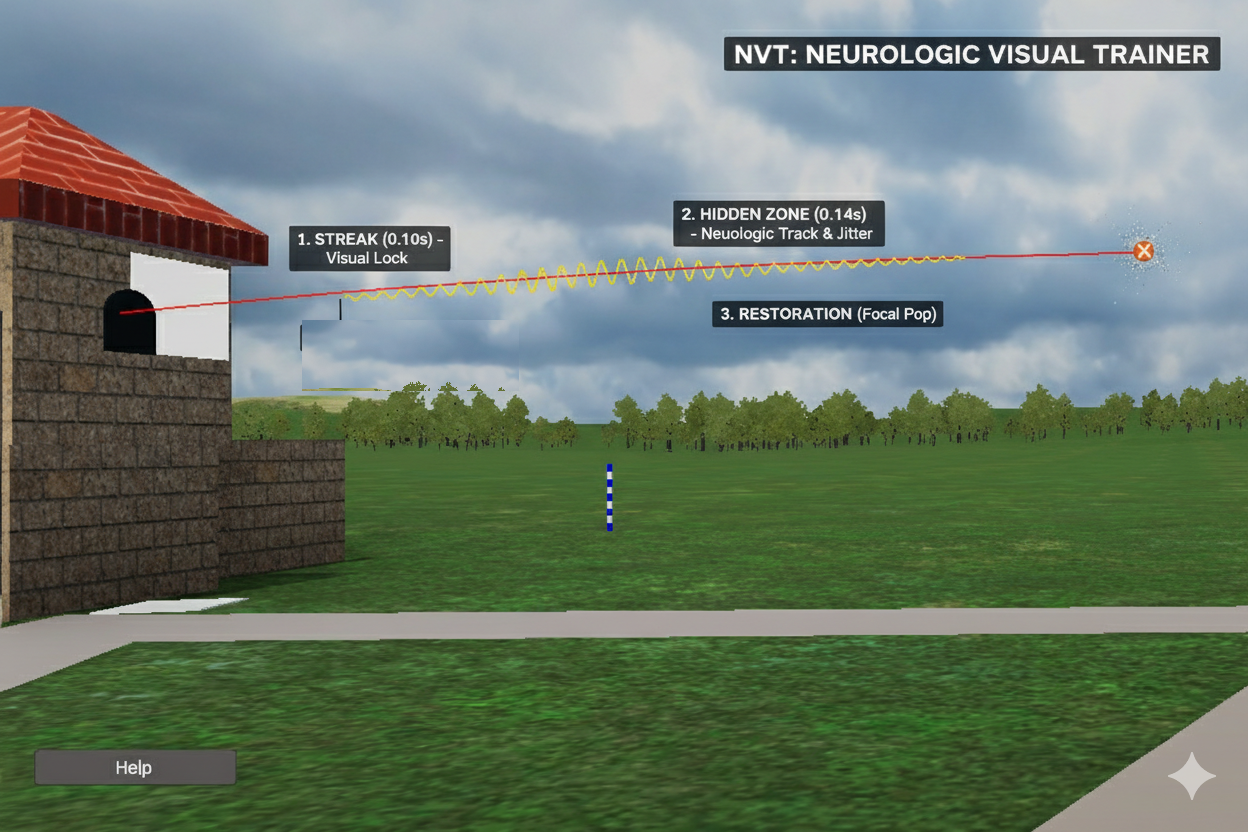
1. Vector Initialization (The Impulse Streak)
The target initializes with a high-fidelity impulse (default 0.10s). This provides a critical but limited data-set for the brain to register vector and velocity without allowing for foveal comfort.
Objective: To force immediate, high-bandwidth neural engagement. Hesitation results in total data-loss, leaving the athlete "chasing a ghost."
2. Cognitive Inference Zone (The Sub-Threshold Phase)
During the mid-flight segment, the system shifts into a Proprietary Obfuscation State. Target scale and luminosity are compressed, and a non-linear Kinetic Distortion Field (0.14s) is applied.
Objective: To inhibit Saccadic jumps. By destabilizing the target's physical edges, the athlete is forced into Smooth Pursuit—modeling the trajectory line via kinesthetic prediction rather than simple ocular tracking.
3. Neural Re-Acquisition (The Restoration Pop)
The target undergoes Instantaneous Restoration to 100% fidelity as it enters the terminal kinetic window.
Objective: To train high-speed focal re-acquisition. This mimics targets transitioning through complex environments (tree-lines or varying light-filters). The athlete must already be "on the line" during restoration to achieve terminal success.
3. Systemic Operational Rhythm
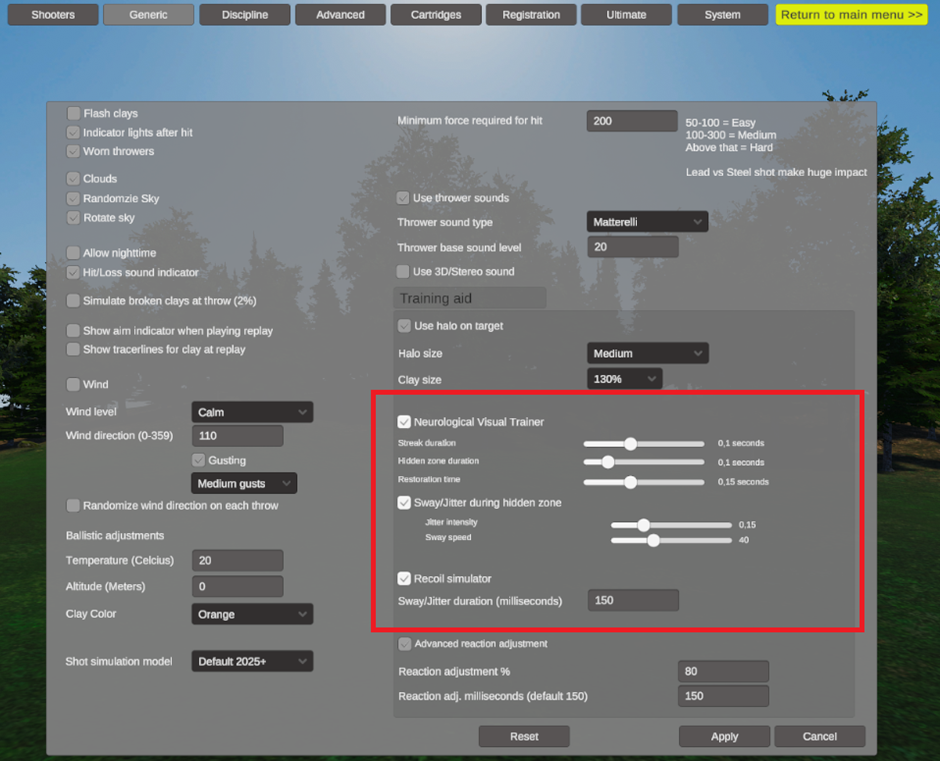
The NVT and Recoil Simulator protocols are designed to move the athlete from manual aiming to Autonomic Neural Flow. Ensure both protocols are initialized in the Configuration -> Generic interface.
Phase 1: Information Lock (The Streak)
Register the initial vector immediately. This is a finite window; the athlete must aggressively lock onto the trajectory to initiate the internal physics model.
Phase 2: Predictive Flow (The Hidden Zone)
As the target enters obfuscation, do not engage in "edge hunting." Maintain a relaxed, broad-band focus and allow the body to flow along the modeled path. Trust the internal neural prediction.
Phase 3: Kinetic Execution (The Restoration)
Execute the motor response the instant Focal Restoration occurs. If the neural prediction was accurate, the target will reappear in sync with the barrel's lead-plane.
Vertical dizziness or ocular fatigue indicates that the athlete is attempting to "hard-lock" on a stochastic object. This creates a sensory mismatch. To rectify, shift to "Soft Focus" and prioritize the flight-path over the individual target vibrations.
4. Training Modalities & Kinetic Intensity
The Visual Sweet Spot: Parametric Calibration
The NVT is a precision instrument. Calibrating settings to "comfortable" levels eliminates the Neurological Adaptive Pressure the system is designed to induce. High-bandwidth neural growth occurs only at the edge of failure.
Kinetic Jitter Modality (Proprietary Default): Uses Pseudo-Random Pathing to disrupt "spot-shooting" dependencies. Athletes must track the core mass through movement noise.
High-Contrast Static Modality: Focuses on Focal Endurance and Contrast Sensitivity by compressing target cross-section without path distortion.
5. Parametric Calibration & Optimization
Calibration Variables:
- Neural Processing Speed: Elite users acquisition data significantly faster (0.10s) vs. foundational users (0.14s).
- Biological Latency: Calibration must account for the athlete’s natural neuro-muscular delay.
- Angular Target Velocity: High-velocity crossing targets (Skeet) require faster processing intervals than rising targets (Trap).
| Distortion Parameter | Input Range | Standard Value | Algorithmic Description |
|---|---|---|---|
| Sway Intensity | 0.0 - 0.5 | 0.15 | The Magnitude: Defines the target's deviation from the true physical path. |
| Sway Speed | 10 - 100 | 40 | The Frequency: Defines the oscillation rate of the obfuscation ghost. |
Calibration Rules:
For Foundational Training, utilize an Intensity of 0.10 and Speed of 20 to establish line-trust. For High-Performance Protocols, increase to Intensity 0.20 and Speed 50+ to force total reliance on trajectory modeling.
6. Advanced User Synthesis (Station-Specific Logic)
TrueClays utilizes Station-Specific Calibration to account for varying acquisition points. This is critical for high-velocity crossing targets (Olympic Skeet Stations 2-6).
- Acquisition Offset: Calibrates the distance the target travels before NVT protocols engage. Shifting this ensures the "Information Lock" happens at the athlete's specific look-point.
- Temporal Compression: As Offset increases, the NVT "clock" must accelerate to ensure the Restoration Pop occurs within the terminal kill-zone.
⚠️ CRITICAL LIMIT: If the combined processing window is compressed below 0.18s total, the neurological benefit is voided. The brain will revert to reactive flicker-response rather than predictive modeling.
7. High-Impulse Recoil Emulation
The Recoil Simulator replicates Post-Shot Concussive Distortion. By injecting Retinal Blur immediately after trigger-activation, it forces the athlete to manage Ocular Reset Latency.
| Ballistic Load | Recovery Duration (ms) | Kinetic Intensity | Neural Objective |
|---|---|---|---|
| 12-Gauge High-Impulse | 150 ms | Tier 1 (0.40) | Simulates Olympic muzzle-flip; trains elite doubles recovery. |
| 20-Gauge Standard | 120 ms | Tier 2 (0.25) | Standardized post-shot reset. |
| Sub-Gauge (.410) | 60 ms | Tier 3 (0.08) | Emphasizes technical reset with minimal concussive shock. |
Algorithmic Basis: The 150ms window emulates Vestibulo-Ocular Stabilization. It prevents "peeking" by punishing head-lift during the post-shot vibration window.
8. Clinical Coaching & Troubleshooting
| Observed Symptom | Systemic Cause | Clinical Rectification |
|---|---|---|
| Kinetic Stalling (Stopping) | Restoration window is too long; waiting for foveal confirmation. | Decrease Restoration Duration. |
| Stochastic Guessing | Inference phase (Hidden) exceeds neural model capacity. | Decrease Hidden Duration. |
| Data Starvation | Initial impulse (Streak) is below recognition threshold. | Increase Impulse Duration (+20ms). |
The "Incremental 10" Rule: Never adjust parametric sliders by more than 10-20ms. The human visual cortex is extremely sensitive; a 30ms variance can transition the athlete from peak performance to total cognitive confusion.
Technical Q&A
Q: Why does the obfuscation feel unrealistic?
A: This is intentional. The NVT is a Neurological Weight Vest. It is designed to remove "lazy" visual crutches. If you can track a stochastic, shrinking ghost, a standard high-contrast bird at the range will appear to move in slow-motion.
Q: I am experiencing vertiginous symptoms during the Jitter phase.
A: This is physical proof of Sensory Conflict. Your brain is overclocking—attempting to solve a visual math problem that isn't meant to be solved. To rectify: Stop "Killing the Ghost." Quiet your eyes, expand your peripheral awareness, and trust the predicted arc.
Q: What is "Neural Flash Response" (False Starts)?
A: This occurs when the athlete reacts to the impulse rather than the vector. To break this habit, utilize the "Identify Color" Drill: Force the brain to mentally name the target color before kinetic movement. This naturally pushes the reaction into the 0.15s+ window where trajectory data is reliable.